
Understanding the Coffee Label
absolutelyroastedcoffee2025-10-03T14:12:02-05:00When purchasing a bag of coffee, sometimes there is a lot of information on the label and you might not be sure what it all means.
I’m going to break down each section of a coffee label or description so you have a general understanding to help you purchase the coffee you want!
What is Origin?
What does “Process” mean and why should I care?
What is variety or varietal?
What are the tasting notes? Does that mean I might be getting something like taffy apple flavored coffee?
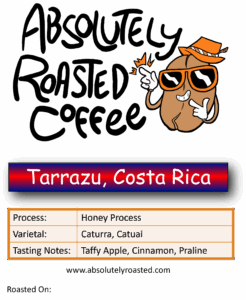
Using our label for our Costa Rica coffee beans, there are four distinct areas:
- Process: Honey Process
- Varietal: Caturra, Catai
- Tasting Notes: Taffy Apple, Cinnamon, Praline
- Roasted On: (varies)
See below for details…
Origin: You might see something like Guji, Ethiopia or Huila, Columbia and in this case Tarrazu, Costa Rica. Tarrazu is the region within Costa Rica where these beans are farmed and/or processed. Single origin coffee (as compared to blends) are typically more bold in flavor which may have notes of flavor such as citrus flavors like tangerine or lemon, chocolate and dark chocolate notes or subtle spice flavors. Soil conditions, elevation, and rainfall are just a few of the variables that can make a variety of the fruit from the same variety of tree taste different. Each region has its own flavor highlights so you can develop an expectation for what this coffee might taste like.
Processing: If you see a label that says “washed” or “natural,” it refers to the process of how the seed is removed from the fruit. A simplified explanation is; the washed process uses water to force the fruit of the seed (bean). A natural process involves letting the fruit dry in the sun which dehydrates the fruit leaving the bean with a fruity skin. These two processes result in different flavors.
Our Costa Rica coffee is processed through a third method called honey process. This process is a hybrid of the two main methods. The outer skin is removed leaving a honey-like mucilage to dry in the sun before being removed for final shipping.
Variety/Varietal: When you see variety or varietal, you might think it belongs to a specific category; however, this is actually how we define the tree it comes from. Specific trees flourish in different environments, but they also have different flavor qualities. Two common varieties of trees are arabica and robusta. From these two types of trees there are many varieties and hybrids.
Tasting notes: After each roast, the coffee goes through a QC session. This is where we taste the coffee for all of its strengths, weaknesses, and flavor profiles. If you see “blueberry,” “cocoa,” or even “floral,” this is what aromas and flavors are coming through the coffee. It is not actually flavored to be a “blueberry coffee.” A properly roasted batch will provide the flavor notes as intended by the farmers and producers. However, if the beans are over-roasted or under-roasted the flavor notes will not be extracted during the brew process.
Dark roast coffees will have little or no flavor notes as the natural proteins, carbohydrates, sugars and acids are transformed in the longer exposure to heat.
Leave a Reply
You must be logged in to post a comment.